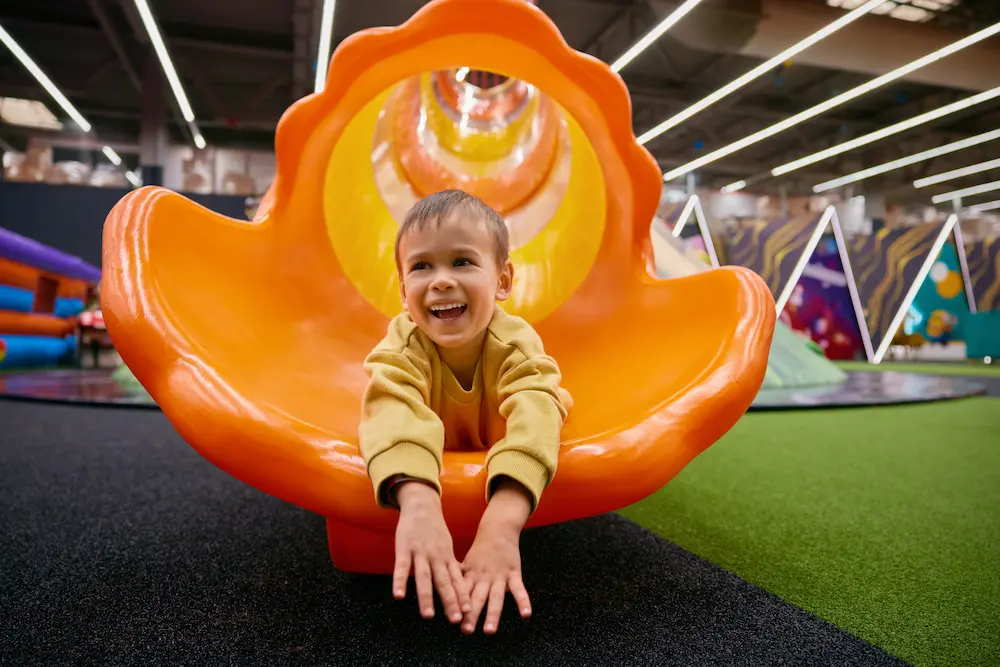
What is meant by a playground?
The term playground refers to an area dedicated to play, equipped with paths, modules, and structures designed to stimulate children’s movement and creativity. Unlike traditional outdoor playgrounds, an indoor playground is designed to be used in enclosed environments, ensuring maximum safety and accessibility in all seasons.
Playgrounds can be divided into different categories based on their intended use:
✔ Playgrounds for playrooms: designed for regular and intensive use, with durable materials and modular courses.
✔ School playgrounds: integrated within educational facilities to support children’s motor development.
✔ Play areas for shopping centers and hotels: safe recreational spaces where children can play while parents engage in other activities.
The defining feature of a playground is its ability to offer diverse play experiences, combining motor, sensory, and social activities in a single space. Structures may include:
✓ Slides, tunnels, and obstacle courses, to stimulate balance and coordination.
✓ Themed areas, which encourage symbolic play and learning.
✓ Safe surfaces and certified materials, to ensure safety and reduce the risk of injury.
An indoor playground must be adaptable and customizable, in order to meet the specific needs of the context in which it is installed. For this reason, choosing modular components and certified materials is essential to ensure a safe and engaging play experience.
Indoor playground: why choose it over an outdoor area?
An indoor playground offers numerous advantages over outdoor play areas, making it an ideal choice for recreational, educational, and commercial facilities.
1. Usable all year round
One of the main limitations of outdoor playgrounds is their dependence on weather conditions. Rain, wind, and extreme temperatures can make outdoor areas inaccessible for long periods, reducing play opportunities. An indoor playground, on the other hand, ensures a safe and protected environment in every season, allowing children to play without interruptions.
2. Greater safety and control
Outdoor spaces can pose risks linked to falls, slippery surfaces, and lack of supervision, especially in public areas with no constant monitoring. A well-designed playground helps create a safe play space, where:
✓ Surfaces are cushioned, reducing the risk of injury.
✓ All components are certified, made of resistant and safe materials with no sharp edges.
✓ The area is enclosed, limiting access and preventing potentially dangerous situations.
This feature is especially important for school facilities and playrooms, where child safety is a top priority.
3. Space adaptability
An indoor playground for playrooms or closed environments can be customized and modular, allowing optimal use of available space and adapting to various age groups.
✔ Flexible configuration: structures can be expanded or modified over time by adding new modules or paths.
✔ Modular solutions: the layout can be easily reconfigured, making the most of square or irregular spaces.
✔ Possibility to integrate educational activities: games with educational elements stimulate creativity and learning.
For those seeking a versatile solution that ensures safe and engaging play throughout the year, an indoor playground is the ideal answer—without space or weather constraints.
How to design a playground for playrooms and indoor settings
Designing an indoor playground for playrooms, schools, or recreational spaces requires careful planning to ensure the space is safe, functional, and engaging. The key to an effective project lies in choosing the right modules and configurations, while maintaining maximum versatility in space usage.
1. Choose the structure based on children’s age
Each age range has different motor and cognitive skills, so the playground must be designed to let every child safely benefit from the equipment.
✔ 1–3 years → Soft play areas with padded structures, small slides, and gentle slopes to support early motor development.
✔3–6 years → Low-level obstacle courses and tunnels to stimulate balance, coordination, and agility.
✔ 6+ years → Taller structures with climbing areas and varied paths, suited for more complex motor challenges.
A well-designed playground allows for the integration of differentiated spaces, adapting to different age groups to ensure an always appropriate gaming experience.
2. Integrate modular paths and themed areas
To keep children engaged, it’s important to create dynamic paths and themed play areas that make playtime more exciting.
✔ Motor courses and tunnels → Modular elements allow for reconfiguration and new challenges.
✔ Themed zones → Castles, animals, kitchens, and more encourage symbolic play and imagination.
✔ Adventure and agility circuits → Nets, climbing walls, and balance games support agility and problem-solving.
A playground for playrooms should always be flexible and upgradable, so as to adapt to changes in educational and play needs.
3. Materials and colors: how to create a welcoming environment
Visual impact is essential to catch children’s attention and make the space more inviting. Bright colors and playful shapes create a vibrant and stimulating atmosphere.
✔ Certified and non-toxic materials → Anti-pollution PVC and resistant fabrics.
✔ Color combinations to stimulate play → Warm colors energize play zones, while cool tones promote calm.
✔ Shock-absorbing surfaces → To ensure safety and reduce injury risks.
A well-designed setup helps create a space that is aesthetically appealing and safe, improving the play experience and ensuring long-term durability.
Playground equipment: what to include?
An indoor playground must include a variety of elements designed to stimulate movement, sociability and creativity. Each component has a specific function, and the combination of multiple structures allows for the creation of a balanced and engaging play environment.
1. Slides and tunnels: stimulate movement
Slides and tunnels are among the most loved structures by children, offering a dynamic and sensory experience.
✔ PP slides → Ideal for toddlers, made of smooth and safe materials.
✔ Tunnels → Allow children to move and explore in a fun way.
✔ Obstacle paths → With cones, beams, and platforms to improve balance and coordination.
2. Psychomotor paths and modular elements: improve coordination
✔ Modular obstacle courses → Designed to create paths that stimulate balance and agility.
✔ Essential soft materials → To ensure safety even in more dynamic play areas.
✔ Low platforms → Suitable for guided motor activities starting at 3 years old.
3. Sensory and interactive areas: enrich the play experience
✔ Tactile and multisensory panels → Stimulate both touch and hand-eye coordination.
✔ Mirrors and visual stimuli → Improve spatial awareness.
✔ Sound and light features → Ideal for engaging younger children.
The integration of these structures makes an indoor playground not only a recreational space, but also an educational one, promoting well-rounded motor and cognitive development.
Would you like to create a safe and customized indoor playground?
Discover the best solutions to design a play area tailored to every need.