Please note: the minimum order amount is €350.
Innovative Educational Toys: Tools for Learning and Creativity
Educational games transform learning into an active, hands-on and engaging experience. Through play, children and young people can experiment, make mistakes, develop new strategies and acquire skills at their own pace.
It is not simply about making a lesson more fun. A well-chosen educational game can stimulate language, logical thinking, memory, creativity, movement and the ability to collaborate with others.
For schools, teachers and educators, educational games are therefore valuable tools for creating more dynamic, inclusive and participation-focused learning environments.
Index
- What are educational games?
- Why play supports learning
- What skills can educational games develop?
- The main types of educational games
- How to choose educational games based on age
- Individual, cooperative and group games
- How to use educational games at school
- Educational games and inclusion
- How to choose safe products suitable for school use
- How to organise an effective learning space
- How to assess the effectiveness of an activity
- The value of durable and versatile educational materials
- Frequently asked questions about educational games
1. What are educational games?
Educational games are materials, activities or tools designed to support the development of one or more skills through play.
They can be used in preschools, primary schools, educational centres, associations, after-school programmes and at home. Some offer structured activities with specific rules and objectives, while others allow for more open-ended use, encouraging creativity and experimentation.
A game can be considered educational when it:
- has a clear and understandable objective;
- is suitable for the children’s age and abilities;
- encourages active participation;
- allows children to try different strategies;
- provides immediate feedback on the activity;
- encourages repetition without making the experience monotonous;
- can be adapted to different levels of difficulty.
The presence of colours, numbers, shapes or letters does not automatically make a product educational. Its value depends above all on how it is integrated into the activity and on the adult’s ability to guide the child without taking over.
2. Why does play support learning?
Play allows children to explore the world through experience. During play activities, they need to observe, remember information, follow rules, control their actions and find solutions.
According to UNICEF, play is one of the main ways children acquire essential knowledge and skills, especially during early childhood. It helps them understand the world around them while developing imagination and creativity.
Play activities can involve several areas of learning at the same time:
- cognitive, through memory, attention and reasoning;
- language, through words, stories and descriptions;
- motor, through manipulation, balance and coordination;
- social, through cooperation and turn-taking;
- emotional, by learning to manage waiting, mistakes and frustration;
- creative, through the development of personal solutions.
The Center on the Developing Child at Harvard University also highlights the importance of executive function skills: abilities that help children focus their attention, remember information, plan and control their behaviour. Age-appropriate games and activities can provide practical opportunities to develop these skills.
3. What skills can educational games develop?
Logical and mathematical skills
Counting, classifying, sorting and recognising quantities are fundamental activities for introducing children to mathematical concepts.
Counting rods, logic blocks, abacuses, shapes and sorting materials make it possible to represent abstract concepts through visible and manipulable objects. Rather than simply listening to an explanation, children can compare, move and directly explore the relationships between different elements.
Language and communication
Picture cards, logical sequences, matching games and storytelling activities can help develop:
- vocabulary;
- sentence building;
- understanding of temporal relationships;
- the ability to describe an experience;
- listening and communicating with others.
Teachers can encourage children to describe what they see, explain their choices or create a story using the available elements.
Fine motor skills
Fitting, stacking, threading, selecting and moving small objects helps children develop hand-eye coordination and precision of movement.
These activities also prepare children for more complex tasks, such as using tools correctly, drawing and writing.
Gross motor skills
Activity courses, hoops, cones, obstacles and psychomotor equipment engage the whole body and can help develop:
- balance;
- coordination;
- spatial awareness;
- laterality;
- movement control;
- body awareness.
Motor activities can also be connected to other areas of learning. For example, colours can be associated with movements, numbers with jumps, or geometric shapes with specific stations along an activity course.
Creativity and problem solving
Open-ended materials, which can be used in different ways, allow children to build, combine and modify freely.
There is not necessarily only one correct solution. Children can develop an idea, test it and change it if it does not work. In this way, they practise flexibility, independence and problem-solving skills.
Social and emotional skills
During group play, children learn to wait for their turn, listen, share materials and accept outcomes that may differ from what they expected.
The goal does not always have to be winning. Many activities can be organised cooperatively, giving the group a common objective to achieve together.
4. The main types of educational games
Logic and maths games
These include counting rods, abacuses, logic blocks, counting sets and materials for classifying shapes, colours, sizes and quantities.
They help make concepts visible and tangible that could otherwise be difficult to understand if presented only in theoretical form.
Construction games
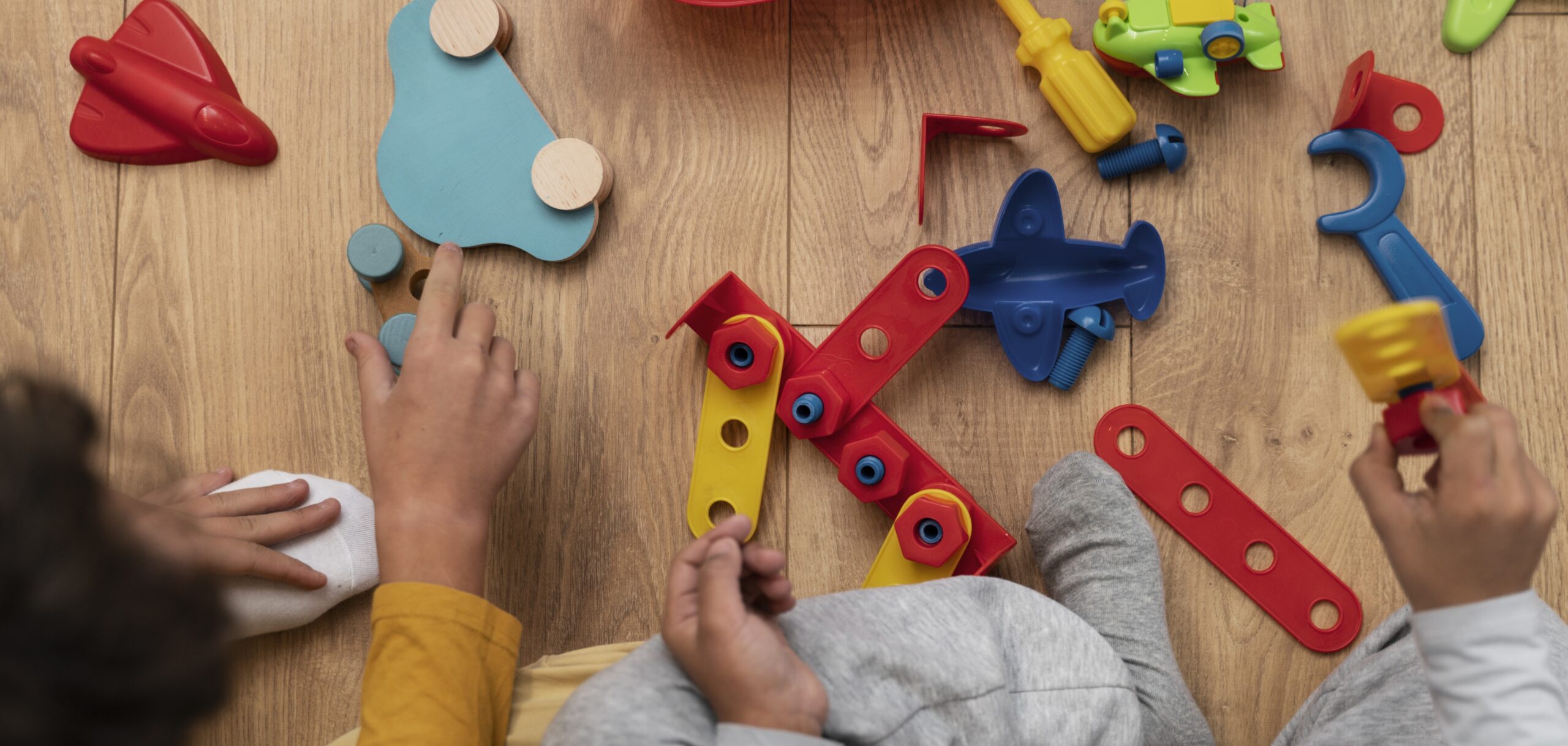
Building blocks, connectable elements and modular structures encourage planning, creativity and spatial awareness.
While building, children need to consider dimensions, stability, balance and the sequence of actions. When the activity is carried out in a group, they also need to discuss ideas and make decisions together.
Sorting and matching games
These activities require children to recognise common characteristics and differences between elements.
For example, children can be asked to group objects by colour, shape or size, or to create sequences according to a specific criterion. By gradually increasing the number of characteristics involved, the activity can become progressively more challenging.
Symbolic play
In symbolic play, children recreate situations they observe in everyday life and invent new scenarios.
This type of activity supports language, imagination and an understanding of social relationships. It can involve settings, characters, constructions and objects that take on different meanings during play.
Motor and psychomotor games
Activity courses, balls, ropes, hoops, clubs, cones and balance equipment can be used to organise motor activities with different levels of difficulty.
They can be used in the gym, in the classroom when space allows, or outdoors. The objective may focus on movement, but also on attention, memory and following a sequence.
Road safety education games
Road signs, traffic lights and simulated road courses help children learn the main rules of the road through practical activities.
Children can take turns playing the roles of pedestrians, cyclists and drivers, learning to recognise road signs, appropriate behaviours and potential hazards.
5. How to choose educational games based on age
The manufacturer’s recommended age is a useful starting point, but it is not the only factor to consider. Children of the same age may have different abilities, interests and learning paces.
Early childhood
It is preferable to choose simple, durable and easy-to-handle materials, with easily recognisable shapes and colours.
Activities can focus on:
- sensory exploration;
- stacking and fitting;
- recognising colours and shapes;
- movement coordination;
- understanding cause and effect.
Preschool
At this stage, sorting, construction, matching and symbolic play activities can be introduced.
Materials that allow children to:
- count small quantities;
- recognise sequences;
- compare shapes and sizes;
- tell stories and describe situations;
- cooperate with classmates;
- develop motor skills
are particularly useful.
Primary school
Games can become more structured and directly linked to learning objectives.
Activities can focus on:
- calculations and numerical relationships;
- geometry;
- logic;
- reading comprehension;
- planning;
- problem solving;
- civic and road safety education;
- cooperation.
6. Individual, paired and group activities
No single approach is always better than the others. The choice depends on the learning objective.
| Format | WHEN IT IS USEFUL | SKILLS DEVELOPED |
|---|---|---|
| Individual |
|
Independence, attention, perseverance |
| In pairs | To compare strategies and encourage dialogue | Listening, communication, negotiation |
| In small groups | To work together towards a shared outcome | Collaboration, responsibility, problem-solving |
| Whole class | To introduce or conclude a shared activity | Participation, sense of belonging, respect for rules |
Group activities are most effective when each participant has a specific role and the outcome depends on everyone’s contribution. Evidence gathered by the Education Endowment Foundation also highlights the importance of clearly structuring collaboration, distinguishing it from simply working together without a shared goal.
7. How to use educational games at school
To achieve real educational value, simply providing the materials is not enough. It is important to plan the activity by defining objectives, rules and timing.
1. Define the objective
Before choosing the game, the teacher should consider which skill they want to observe or develop.
The objective could be to:
- recognise colours;
- count to ten;
- follow a sequence;
- cooperate;
- improve balance;
- describe an experience;
- find multiple solutions to the same problem.
2. Give clear instructions
The explanation should be simple and, whenever possible, accompanied by a brief demonstration.
Too many rules introduced at the same time can make the activity difficult to understand. It is better to start with a simple version and gradually introduce new variations.
3. Leave room for experimentation
The adult should guide the activity without immediately providing the solution.
Questions such as “What could you try?”, “Why did you choose this element?” or “Is there another way?” help children reflect and express their reasoning.
4. Provide different levels of difficulty
The same activity can be adapted by changing:
- the number of elements;
- the time available;
- the number of rules;
- the length of the sequence;
- the type of collaboration required;
- whether or not a visual model is provided.
5. End with a moment of reflection
At the end of the activity, it is useful to ask children what they did, what difficulties they encountered and how they overcame them.
This helps transform the experience into a greater awareness of their own learning process.
8. Educational games and inclusion
Educational games can help create a more inclusive learning environment when they offer different ways for children to participate.
An activity can be made more accessible through:
- large, easy-to-grasp elements;
- easily recognisable colours and clear contrasts;
- instructions supported by visual examples;
- simple and progressive rules;
- flexible timing;
- materials that can be used in different ways;
- cooperative activities without elimination;
- opportunities to participate through movement, language or hands-on activities.
Adapting an activity does not necessarily mean creating a separate one. It is often possible to maintain the same objective while changing the way each child can achieve it.
Teacher observation remains essential to understand which adaptations are genuinely useful for the group and for individual participants.
9. How to choose safe products suitable for school use
In schools and educational environments, materials are used frequently and by many children. For this reason, they should be evaluated not only on their appearance, but also in terms of safety, durability and ease of maintenance.
Before purchasing, it is advisable to check:
- age range and intended use;
- availability of the required product information;
- materials and build quality;
- stability and durability;
- absence of sharp edges or potentially hazardous parts;
- dimensions suitable for the intended users;
- easy-to-clean surfaces;
- availability of spare parts;
- instructions for use and maintenance;
- any applicable certifications or technical standards.
It is also important to distinguish between toys, playground equipment, school furniture and sports equipment, as these categories may be subject to different requirements and standards.
European legislation establishes specific safety requirements for products designed or intended for children’s play. For further information, you can consult the official European Union documentation on toy safety.
10. How to organise an effective learning space
The way the environment is organised also influences how children use educational games.
A well-organised space should be:
- easy to understand and navigate;
- safe to move around;
- organised without being overly rigid;
- accessible to children;
- adaptable for individual and group activities;
- equipped with clearly identifiable storage;
- easy to tidy up.
It can be useful to divide the environment into dedicated areas for:
- logic and maths;
- construction;
- reading and storytelling;
- creativity;
- symbolic play;
- movement and psychomotor activities.
Not all materials need to be available at the same time. Rotating materials regularly helps maintain children’s interest and allows teachers to offer experiences that are consistent with the current learning programme.
11. How to assess the effectiveness of an activity
To understand whether an educational game is truly effective, teachers can observe several practical aspects.
Participation
Do the children show interest? Do they understand what they need to do? Can they maintain their attention for an appropriate amount of time?
Independence
Can they use the materials without constantly relying on an adult? Do they try different strategies before asking for help?
Learning
Can the skills practised during the activity be applied in other contexts? Can the child explain what they have done?
Collaboration
Do participants share materials and decisions? Does everyone have a role, or are some children left out?
Level of difficulty
Is the activity challenging enough without becoming frustrating? Can it be simplified or made more complex?
Observations can be recorded on a simple sheet, noting the date, activity, objective, level of participation and any adaptations to be introduced.
12. The value of durable and versatile educational materials
An educational game designed for schools and public environments should support a wide range of activities and withstand frequent use.
Versatility makes it possible to use the same material for different learning objectives. A set of shapes, for example, can be used to recognise colours, count, classify, create sequences or invent compositions.
The possibility of using the same product in different contexts allows schools to:
- optimise their investment;
- reduce the amount of rarely used materials;
- create interdisciplinary activities;
- adapt activities to different ages and abilities;
- encourage continuity between free play and structured activities.
For this reason, Italveneta Didattica develops educational, psychomotor and sports equipment designed for use in schools and collective environments, with particular attention to quality, safety and durability.
13. Frequently asked questions about educational games
- What is an educational game?
An educational game is an activity or material that uses play to support the development of knowledge and cognitive, language, motor, creative or social skills.
- What is the difference between an educational game and a learning game?
The two terms are often used interchangeably. In general, a learning game is linked to a specific learning objective, while an educational game may also include experiences that support the child’s overall development.
- Are educational games only suitable for preschool children?
No. They can also be used in primary school and, with age-appropriate activities, at later educational stages. The complexity, rules and learning objectives should be adapted accordingly.
- How do you choose an educational game for the classroom?
It is important to consider the age of the pupils, learning objective, number of participants, available space, safety, durability and the possibility of adapting the activity to different ability levels.
- Is individual or group play better?
It depends on the skill you want to develop. Individual play encourages concentration and independence, while group play supports cooperation, communication and respect for rules.
- Can an educational game be used across different subjects?
Yes. The most versatile materials can connect mathematics, language, movement, creativity and civic education. Their effectiveness depends on how the teacher structures the activity.
- How can an educational game be made more inclusive?
Rules can be simplified, visual aids can be used, timing can be adjusted, smaller groups can be created and different roles can be assigned. Offering different ways to participate allows children to work towards the same objective according to their abilities.
- What features should a game designed for intensive school use have?
It should be safe, durable, easy to clean, age-appropriate, easy to store and ideally suitable for different activities. It is also important to check the technical information, instructions and applicable standards.
Bring new opportunities for learning through play into the classroom
Every educational environment has different needs. Choosing the right educational games means considering the children’s age, the skills to be developed, the available space and frequency of use.
Discover Italveneta Didattica’s educational range: logic and maths materials, creative games, psychomotor equipment and solutions designed to help schools, teachers and educators create engaging and safe learning experiences.