
Please note: the minimum order amount is €350.
Outdoor playground equipment: materials, safety and durability

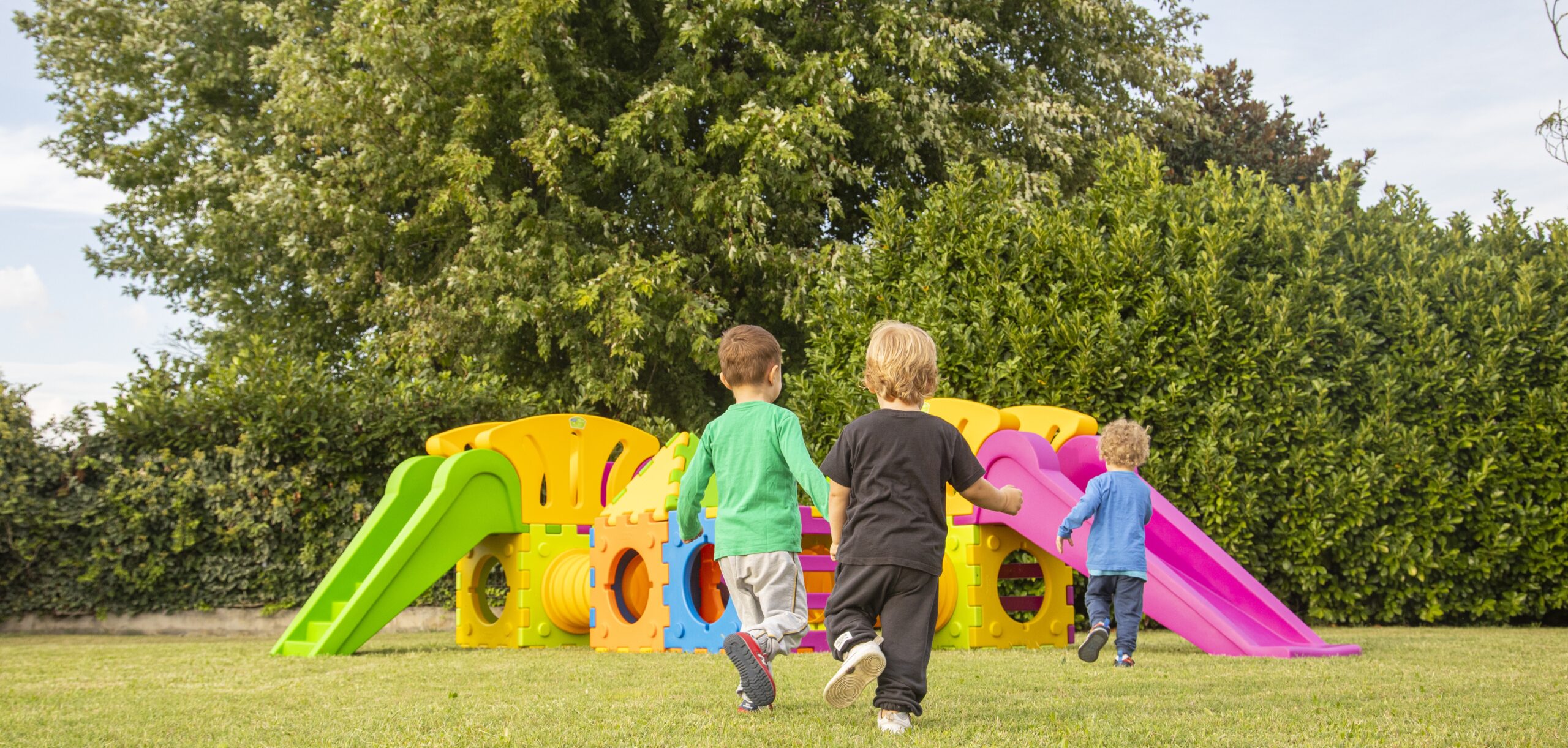
Commercial outdoor playground equipment plays a central role in the design of spaces dedicated to children. Schools, nurseries, campsites, holiday parks, restaurants and hospitality facilities need to choose equipment that provides fun, safety and long-lasting durability.
The choice should therefore not be based solely on appearance or initial price. Playground equipment installed in a public environment is used frequently, exposed to weather conditions and needs to be easy to clean and inspect.
For this reason, it is important to carefully evaluate the materials, structure, compliance with applicable standards and availability of spare parts. Well-designed commercial playground equipment can become a long-term investment, helping to reduce maintenance, replacements and operating costs over time.
Index
- What is outdoor playground equipment?
- Why choose commercial playground equipment?
- Which materials are best for outdoor playground equipment?
- Plastic in playground equipment for public use
- Safety and applicable standards
- Weather resistance
- Maintenance, cleaning and spare parts
- How to choose the right playground equipment
- Why durability affects the real cost
- Frequently asked questions
- Discover Italveneta Didattica’s professional playground equipment
1. What is outdoor playground equipment?
The term “outdoor playground equipment” refers to larger play structures designed to encourage movement, exploration and shared play.
These can include:
- play towers and modular structures;
- tunnels and passageways;
- modular play cubes;
- slides;
- motor skills courses;
- climbing structures;
- play panels and interactive components;
- playground equipment for outdoor areas in schools and family-oriented facilities.
This equipment allows children to experience a variety of activities: entering, exiting, crawling through, climbing, hiding and creating new play scenarios.
In addition to providing opportunities for play, it can contribute to the development of motor skills, spatial awareness, coordination and social interaction.
2. Why choose commercial playground equipment for public spaces?
Playground equipment designed for a private garden is not used as frequently as equipment installed in a school, campsite or public recreational area.
In shared and public spaces, playground equipment is subject to:
- frequent use by many children;
- repeated stress and wear;
- exposure to sun, rain and temperature changes;
- frequent cleaning;
- regular inspections;
- occasional relocation or reconfiguration.
For these reasons, it is important to choose playground equipment specifically designed for intensive use. Suitable materials, robust components and a reliable construction system can make a significant difference to the lifespan of the equipment.
Commercial playground equipment also provides greater benefits for those responsible for managing the space, as it makes maintenance easier to plan and reduces the risk of having to replace the entire structure if a single component becomes damaged.
3. Which materials should you choose for outdoor playground equipment?
The material is one of the first factors to consider when choosing outdoor playground equipment. Each solution has different characteristics in terms of durability, maintenance, weight and performance in outdoor environments.
Plastic
High-quality plastic is particularly suitable for schools and family-oriented facilities, as it can be used to create colourful, durable and easy-to-clean playground equipment.
The main advantages include:
- no splinters;
- washable surfaces;
- good resistance to moisture;
- rounded shapes;
- possibility of creating modular components;
- colours integrated into the material;
- low maintenance requirements.
However, the quality of the raw material and the manufacturing process remain essential. Not all plastics have the same properties, and not all plastic playground equipment is designed for public or intensive use.
Wood
Wood offers a natural appearance and blends easily into parks and green spaces. However, it requires regular inspections and treatments to protect it from moisture, sunlight, fungi and deterioration.
Over time, it may be necessary to check for cracks, splinters or damaged components.
Metal
Metal provides high structural strength, but it must be properly treated to protect it against corrosion and rust. Surfaces exposed to direct sunlight can also reach high temperatures.
In playground equipment for children, metal is often used in combination with other materials, particularly for connections, supports and structural components.
4. Plastic in playground equipment for public use
Plastic used to manufacture commercial playground equipment can offer significant advantages in the day-to-day management of a play area.
Smooth, washable surfaces make cleaning easier. Resistance to moisture also allows the equipment to be installed outdoors and in areas that require frequent cleaning.
Another important advantage is the possibility of manufacturing components with rounded shapes and without particularly sharp edges. In modular playground equipment, individual elements can be designed to create different configurations and adapt to the available space.
However, it is also important to consider:
- quality and thickness of the material;
- colour stability;
- strength of connections;
- availability of replaceable components;
- intended use specified by the manufacturer;
- installation and maintenance instructions.
Simply defining a product as “plastic playground equipment” is therefore not enough to assess its quality. The overall design, materials and construction of the product must also be considered.
5. Safety and applicable standards
When playground equipment is installed in a school or a space accessible to the public, safety must be a priority.
The main European technical standard for playground equipment and surfacing is the EN 1176 series. Its application depends on the type of product, its configuration and intended use.
The assessment of playground equipment should consider several factors, including:
- structural stability;
- strength of connections;
- absence of hazardous points;
- dimensions of openings and passageways;
- risk of entrapment;
- fall height;
- required safety space around the equipment;
- the surface on which the equipment is installed;
- installation and anchoring methods;
- inspection and maintenance requirements.
It is always important to check the technical documentation provided by the manufacturer and ensure that the product is suitable for the environment in which it will be used.
Correct installation is equally important. Even high-quality playground equipment can lose some of its intended safety characteristics if it is installed on an unsuitable surface or without respecting the required safety distances.
6. Resistance to sunlight and weather conditions
Outdoor playground equipment remains exposed for long periods to sunlight, rain, moisture and temperature changes.
To assess its durability, it is important to consider:
- how the material performs under prolonged sun exposure;
- colour resistance;
- ability to withstand temperature fluctuations;
- resistance to water and moisture;
- quality of connections and joining components;
- any protective treatments;
- recommended cleaning methods.
No material is completely immune to wear. The difference lies in how quickly the product deteriorates and whether individual components can be repaired or replaced without replacing the entire structure.
For this reason, commercial playground equipment should be designed not only to withstand outdoor conditions, but also to allow for effective inspection and maintenance throughout its lifespan.
7. Maintenance, cleaning and spare parts availability
Maintenance is essential to preserve the functionality and safety of any playground equipment over time.
Regular inspections should check:
- overall stability;
- tightness of connections;
- condition of surfaces;
- any damage or deformation;
- presence of loose components;
- cleanliness of passageways;
- condition of the surrounding area.
The possibility of replacing individual components is a significant advantage. If a tunnel, panel, roof or connecting element becomes damaged, having a replacement part available can avoid the need to replace the entire structure.
Before purchasing, it is therefore useful to ask the supplier:
- whether spare parts are available;
- how long they will remain available;
- whether the structure can be expanded;
- whether the components can be reconfigured;
- what after-sales support is provided.
A reliable after-sales service directly contributes to the long-term value and lifespan of the investment.
8. How to choose the right outdoor playground equipment
The choice should be based on the actual characteristics of the space and the intended use.
Age of the children
The playground equipment should be suitable for the motor skills and physical abilities of the children who will use it. Equipment designed for a nursery school will have different characteristics from a structure intended for older children.
Number of users
In a school, campsite or holiday park, the playground equipment may be used by several children at the same time. It is therefore important to choose a configuration that encourages easy movement and shared play.
Available space
It is important to consider not only the dimensions of the structure itself, but also the required space around the equipment, access points, distances from walls and fences, and any necessary safety surfacing.
Indoor or outdoor installation
Some structures can be used both indoors and outdoors, but it is always necessary to check the manufacturer’s instructions and ensure that the specific configuration is suitable for the intended installation environment.
Type of activity
Tunnels, passageways and cubes encourage exploration and movement. Slides and activity courses introduce different types of motor activities, while modular structures make it possible to create more varied and flexible configurations.
Long-term management
A good purchasing decision should also consider future requirements, including cleaning, maintenance, spare parts, possible extensions and after-sales support.
9. Why durability affects the true cost of playground equipment
Comparing two pieces of playground equipment based solely on their initial price can lead to an incomplete assessment.
The true cost also includes:
- purchase price;
- transport and installation;
- maintenance;
- any protective treatments;
- availability and cost of spare parts;
- expected lifespan;
- possibility of expanding or reconfiguring the equipment;
- potential replacement costs.
A low-cost product that requires frequent maintenance or needs to be replaced after only a few years may ultimately be less cost-effective than commercial playground equipment designed to last.
For schools and family-oriented facilities, continuous availability also represents real value. Durable playground equipment reduces service interruptions and helps keep the play area available, safe and welcoming for children.
10. Frequently asked questions about outdoor playground equipment
- What is the best material for outdoor playground equipment?
It depends on the environment, frequency of use and maintenance requirements. High-quality plastic is particularly suitable when washable surfaces, moisture resistance, rounded shapes and low maintenance are important.
- Can plastic playground equipment be left outdoors?
Yes, provided that it is designed and specified by the manufacturer for outdoor use. It is important to check the material properties, weather resistance and installation requirements.
- Which standard applies to playground equipment installed in public areas?
The main European reference for playground equipment and surfacing is the EN 1176 series. The applicable requirements should be assessed according to the type of product, its configuration and intended use.
- Is purchasing certified playground equipment enough to ensure safety?
No. In addition to the characteristics of the equipment itself, proper planning of the play area, installation according to the manufacturer’s instructions, suitable surfacing and regular inspections are essential.
- How long can outdoor playground equipment last?
The lifespan depends on the materials, construction quality, intensity of use, exposure to weather conditions and maintenance. Professionally designed playground equipment that is correctly installed and regularly inspected can remain in use for many years.
- Can only the damaged part be replaced?
It depends on the construction system. With modular playground equipment designed with replaceable components, it is often possible to replace an individual element without having to replace the entire structure.
- How should large plastic playground equipment be cleaned?
It is important to follow the manufacturer’s instructions and use cleaning products that are compatible with the material. In general, plastic surfaces can be cleaned easily, avoiding abrasive detergents or tools that could scratch them.
- Can modular playground equipment be expanded over time?
Some modular systems allow components to be added or replaced over time. This possibility should be checked before purchasing, together with the future availability of compatible components.
11. Discover Italveneta Didattica’s professional playground equipment
Since 1978, Italveneta Didattica has been designing and manufacturing plastic playground equipment in Italy for schools, nurseries and public facilities.
Our manufacturing experience allows us to directly oversee material quality, component production and the long-term availability of spare parts. Our modular structures can be configured according to the available space, the age of the children and the intended use.
Are you planning a new play area or renovating an existing one?
Discover our commercial playground equipment and professional solutions and contact us for technical information, advice on the most suitable solution for your space and a customised proposal.
